10 roof framing mistakes that cost you time and lumber
Most bad rafters are not cut wrong. They are marked wrong, laid out from the wrong reference, or measured with a tool that lied. Here are the ten mistakes that burn the most boards, and how to stop making them.
A roof is repetition: the same rafter, cut dozens of times, meeting a ridge that does not forgive. That repetition is what makes framing mistakes expensive. An error you would shrug off on one board gets multiplied across the whole run, and by the time it shows up as a wavy ridge or a birdsmouth that will not seat, the lumber is already cut. Every mistake below is fixable at the layout stage, which is exactly where most of them start.
1. Measuring rafter length from the wrong reference point
The single most common rookie error: calculating rafter length to the center of the ridge and forgetting that a ridge board has thickness. Each rafter must be shortened by half the ridge thickness, three quarters of an inch for a 2× ridge, measured perpendicular to the plumb cut. Skip the deduction and every rafter lands long, the ridge gets pushed off center, and the pairs never meet cleanly. Do the math once, write the deduction on the pattern rafter, and apply it to every board. If you are still getting comfortable converting pitch to lengths, start with our primer on roof pitch before you touch a saw.
2. Ignoring the crown
Almost every piece of framing lumber has a crown, a slight bow along its length. Sight down each board before layout and mark the crown, then frame with every crown up. Gravity and roof load will flatten crowned-up rafters toward straight over time. Mix crown-up and crown-down rafters in the same roof and you build a permanent wave into the plane; the sheathing telegraphs every hump. Sighting boards takes seconds per rafter and it is the cheapest straight roof you will ever buy.
3. Overcutting the birdsmouth
The birdsmouth, the notch where the rafter seats on the wall plate, has hard limits: cut the seat too deep and you have gutted the rafter right where it carries load, and most codes cap the notch so at least two thirds of the rafter depth remains. The usual failure is running the saw past the layout lines to free the waste instead of finishing the corner with a handsaw or jigsaw, leaving overcuts that weaken the heel. Mark both lines cleanly, cut to them and not through them, and finish by hand. We cover the full sequence in our guide to marking birdsmouth cuts.
4. Marking layout on the worst edge of the board
A traditional square registers against one edge, so your line is only as straight as the edge you hook it on. Framing stock arrives with rounded arrises, forklift dings, and torn grain, and if that is the edge your fence rides, the defect transfers straight into your layout. The habit fix is to sight both edges and register on the better one. The tool fix is a square that does not care: a double-sided square registers on the faces of the board instead of a single edge, so the line stays perpendicular no matter what shape the edge is in.
5. Flipping the square and letting lines drift
To carry a cut line around a 2×, the single-sided routine is mark a face, flip the square over the edge, re-register, and mark again. Every flip re-introduces a little error, and the line on the far face rarely lands exactly opposite the first. On a cross-cut you might not notice; on a plumb cut that has to mate with a ridge, an eighth of drift shows. Slow down, keep the fence tight on every re-registration, and check that the lines meet at the edge. Or skip the flip entirely: a double-sided square straddles the board and marks both faces and the top edge in one motion, so there is nothing to re-register and nothing to drift.
6. Not accounting for wane on rough stock
Wane is the missing corner left when the mill saws near the outside of the log, bark edge instead of square arris. Hook a square's fence on a waney edge and the tool tips into the void, throwing the line out of square before the pencil moves. On rough or budget lumber, check every board for wane before layout and either mark from the sound edge or use a square that registers on the faces, where wane cannot reach. Wane also matters at bearing points: keep waney sections out of the birdsmouth seat and away from hanger nailing.
7. Skipping the test rafter
Gang-cutting is how production framers make money, and it is also how one bad layout becomes twenty bad rafters. Before you cut the stack, cut one pattern rafter and physically try it: set it on the plates, check the plumb cut against a scrap standing in for the ridge, confirm the birdsmouth seats flat and the overhang lands where the fascia wants it. Five minutes of proving the pattern protects every board behind it. Only after the test rafter fits do you trace it onto the rest.
8. Sloppy on-center spacing transfer
Rafter layout has to match the wall plate layout below it and land on sheathing edges above it. The classic errors are pulling 16 or 24 inch centers from the wrong starting point, forgetting to hold the first rafter to the edge so sheathing breaks on center, and measuring each space from the last rafter instead of from a single reference end, which stacks pencil-width errors down the whole plate. Pull all your centers from one end with the tape hooked once, mark an X on the same side of every line, and transfer plate layout to the ridge before anything goes up in the air.
9. Thick lines on precision cuts
A dull carpenter's pencil leaves a line an eighth of an inch wide, and a saw kerf is about that too. If you do not know which side of a fat line to cut, you can be off almost a quarter inch before the blade ever wanders. Keep the pencil sharp, or switch to a mechanical pencil or a knife line for joinery-grade cuts like birdsmouths and plumb cuts. Just as important, be consistent: always cut on the waste side, and decide once whether your mark is the line or the shoulder of the line.
10. Trusting a damaged or out-of-square tool
A square that has been dropped on concrete, cooked on a dashboard, or worn round at the fence will happily mark all day, wrong. Check your square periodically: scribe a line, flip the square, and scribe again along the same edge; if the two lines diverge, the tool is out. A tape with a loose hook, a level that has been used as a pry bar, same story. The layout tools are the cheapest things on the site and they control everything downstream, so retire the suspects. Our walkthrough on how to use a rafter square includes the flip test and the habits that keep a square accurate.
The square that removes three of these mistakes
Look back at mistakes 4, 5, and 6 and you will notice they share a cause: a single-sided square that depends on one edge of the board and has to be flipped to finish the line. The Rapid Rafter was invented to remove that cause. It is a patented dual-sided square, U.S. Patent No. 11,654,545, from master carpenter Peter Toomey of Liberty Hill, Texas, building since 1984 and founder of All Seasons Decks & Gazebos. In the open position it marks three sides of any 2× material in one motion, both faces and the top edge, and because it registers on the faces you get a perfect perpendicular line regardless of the quality of the board. Folded flat, it works as a normal everyday square. See the full motion on our how it works page.
The Original is $27.99, made in the USA from a proprietary polymer. The aluminum Pro is $59.99, with a 3"/4"/6" Base-Plate Kit at $59.99 and a Pro Bundle at $109.99. Popular Mechanics named it Gear of the Year 2025, it won an LBM Journal 2026 Innovation Award, and it is available at The Home Depot. Free U.S. shipping, 30-day returns, 1-year warranty.
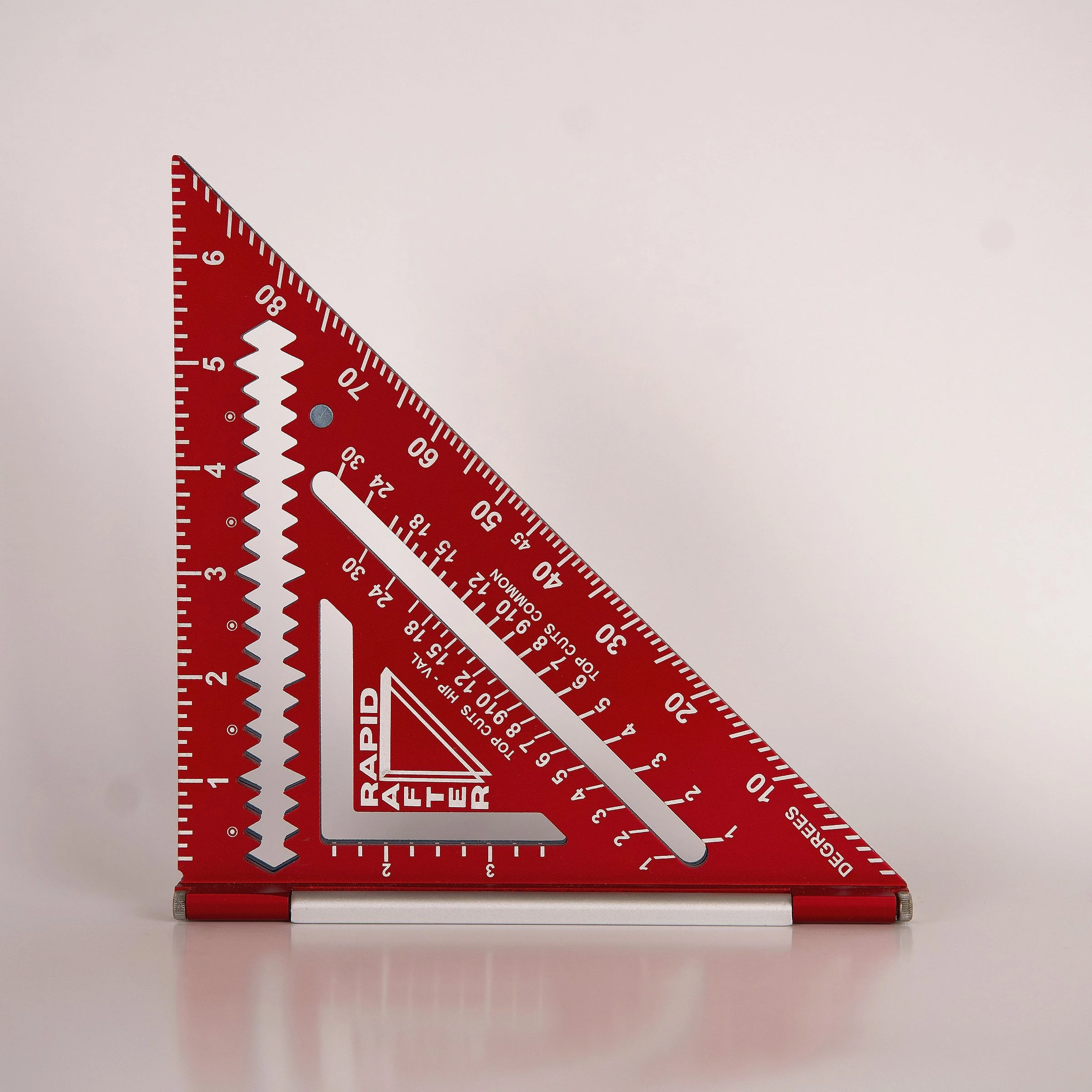
Stop flipping the square and letting lines drift
- Marks three sides of 2× material in one motion: both faces and the top edge
- Aluminum body, laser-etched scales, wider scribe
- Patented double-sided square, Popular Mechanics Gear of the Year 2025
Working doubles, LVL or posts? The Pro Base-Plate Kit adds 3″, 4″ and 6″ plates, $59.99. Buy the kit
Free U.S. shipping ·30-day returns ·1-year warranty
Stop flipping. Start framing.
One motion marks both faces and the top edge, square every time, on any board.