Essential framing tools: what belongs in a framer's kit
Framing does not take a truck full of gadgets. It takes a short list of tools that measure, mark, cut, and fasten, and that keep doing it after they hit the ground.
Walk any framing job and you will see the same core kit on every belt, whatever the brand names stamped on the tools. That is because framing is a repeatable sequence: measure, mark, cut, fasten, check for level and plumb. Each tool below earns its place by doing one of those jobs fast and surviving the environment. Here is the list, category by category.
Framing hammer or framing nailer
Fastening is the heartbeat of the job. A framing hammer runs heavier than a finish hammer, usually 20 to 28 ounces, with a milled face that grips nail heads on off-angle swings and a straight claw for prying and demolition. A pneumatic or cordless framing nailer multiplies your pace on production work: walls, sheathing, decking. Most framers carry both, because a nailer will not toenail into a tight corner or persuade a stubborn stud over to its layout line the way a hammer will.
Circular saw
The circular saw is the framer's primary cutting tool. A 7-1/4 inch blade crosscuts 2× stock in one pass and handles sheet goods, rips, and bevels. Corded saws still rule for all-day production; modern cordless saws are close enough that many crews have switched. Whichever you run, keep a sharp framing blade in it and learn to run the shoe against a square for dead-straight crosscuts.
Squares: rafter, framing, and combination
Squares do the layout work that separates a frame that goes together from one that fights you. Three kinds matter, and they are not interchangeable.
The rafter square (also sold as a triangle square) is the flat triangle with a lipped fence and degree and pitch scales along the hypotenuse. It marks square crosscuts, lays out plumb cuts and birdsmouths by pitch, and doubles as a saw guide. It is the most-reached-for tool on this list. For how the traditional design compares, see our guide to single-sided vs. double-sided rafter squares sorts them out.
The framing square is the big flat L, a 24 inch blade and 16 inch tongue, used for stair stringer layout, checking corners for square, and full rafter tables on bigger roof work.
The combination square has a sliding head on a 12 inch rule, for transferring depths, scribing lines parallel to an edge, and checking 45 and 90 degree cuts on trim-adjacent work.
One thing to know before you buy a triangular square: the traditional design is single-sided. It registers against one edge and marks one face at a time, so carrying a line around a 2× means mark, flip the square over the board, re-register, and mark again, and the lines do not always meet on the far side. If the board's edge is rounded, torn, or waney, the line follows the defect. The Rapid Rafteris the double-sided answer to that problem: in the open position it marks three sides of any 2× material in one motion, both faces and the top edge, and because it registers on the faces it gives you a perfect perpendicular line regardless of the quality of the board. Folded flat, it works as a normal everyday square. It is a patented design, U.S. Patent No. 11,654,545, invented by master carpenter Peter Toomey of Liberty Hill, Texas, building since 1984 and founder of All Seasons Decks & Gazebos. Popular Mechanics named it Gear of the Year 2025 and it won an LBM Journal 2026 Innovation Award.
Tape measure and chalk line
A 25 foot tape with a wide, stiff blade covers nearly everything in framing; the extra standout matters when you are measuring plates alone. Look for large, high-contrast markings and clear stud-layout highlights at 16 and 24 inch intervals. The chalk line is the long-distance partner: snap wall lines on the deck, sheathing cuts, and rafter tail trim lines. Keep one filled with a chalk color you can see on your lumber, and remember red chalk is permanent on most surfaces, so save it for lines that will be covered.
Levels
Two levels handle framing. A torpedo level rides in the pouch for quick checks on short stock, blocking, and anything in a tight spot. A 4-foot level is the standard for plumbing walls and posts and leveling headers; its length averages out the crown and cup in any single stud. Treat levels gently and check them now and then by flipping them end for end on the same surface: a level that reads differently in each direction is lying to you.
Pencils, markers, and sawhorses
Carpenter's pencils hold a wide, durable line on rough lumber and sharpen with a knife. Keep a lumber crayon or a permanent marker for wet wood and pressure-treated stock where graphite disappears. Buy them by the box, because they leave the jobsite faster than any other tool. A pair of sturdy sawhorses rounds out the kit: they turn any patch of ground into a cutting station and a layout bench, and the folding steel or heavy plastic ones stack flat in the truck.
Fall protection and PPE
None of the above matters if you go home hurt. Safety glasses stay on whenever a saw or nailer is running, hearing protection whenever you are cutting for more than a minute, and gloves for handling rough and treated lumber. Once the work leaves the ground, fall protection is not optional: a harness and anchor rated for the work, guardrails where they apply, and footwear with real grip. Requirements vary by height and jurisdiction, so know the rules that apply to your site before you climb.
What makes a tool jobsite-worthy
Three tests separate jobsite tools from garage tools. Drop survival: everything on this list will eventually fall off a ladder, a wall plate, or a roof, and a tool that goes out of true or cracks on the first drop is a liability. Readable scales: markings you can read in glare, shade, and sawdust, at arm's length, without hunting. One-hand operation: on a wall or a roof, your other hand is holding the work or holding on, so a tool you cannot deploy, use, and stow one-handed will stay in the pouch.
Buy once
The whole kit above is modest money compared to almost any other trade's startup cost, and the temptation is to cheap out across the board. Resist it on the tools that touch accuracy: squares, tapes, and levels. A square that is not square poisons every cut you make with it, and you will not know until the frame tells you. Buy the accurate tool once, treat it decently, and it outlasts a drawer full of replacements. The Rapid Rafter line follows that philosophy: the Original is $27.99, made in the USA from a proprietary polymer, and the aluminum Pro is $59.99, with a 3"/4"/6" Base-Plate Kit at $59.99 and a Pro Bundle at $109.99. Every order ships free in the U.S. with 30-day returns and a 1-year warranty, and it is available at The Home Depot.
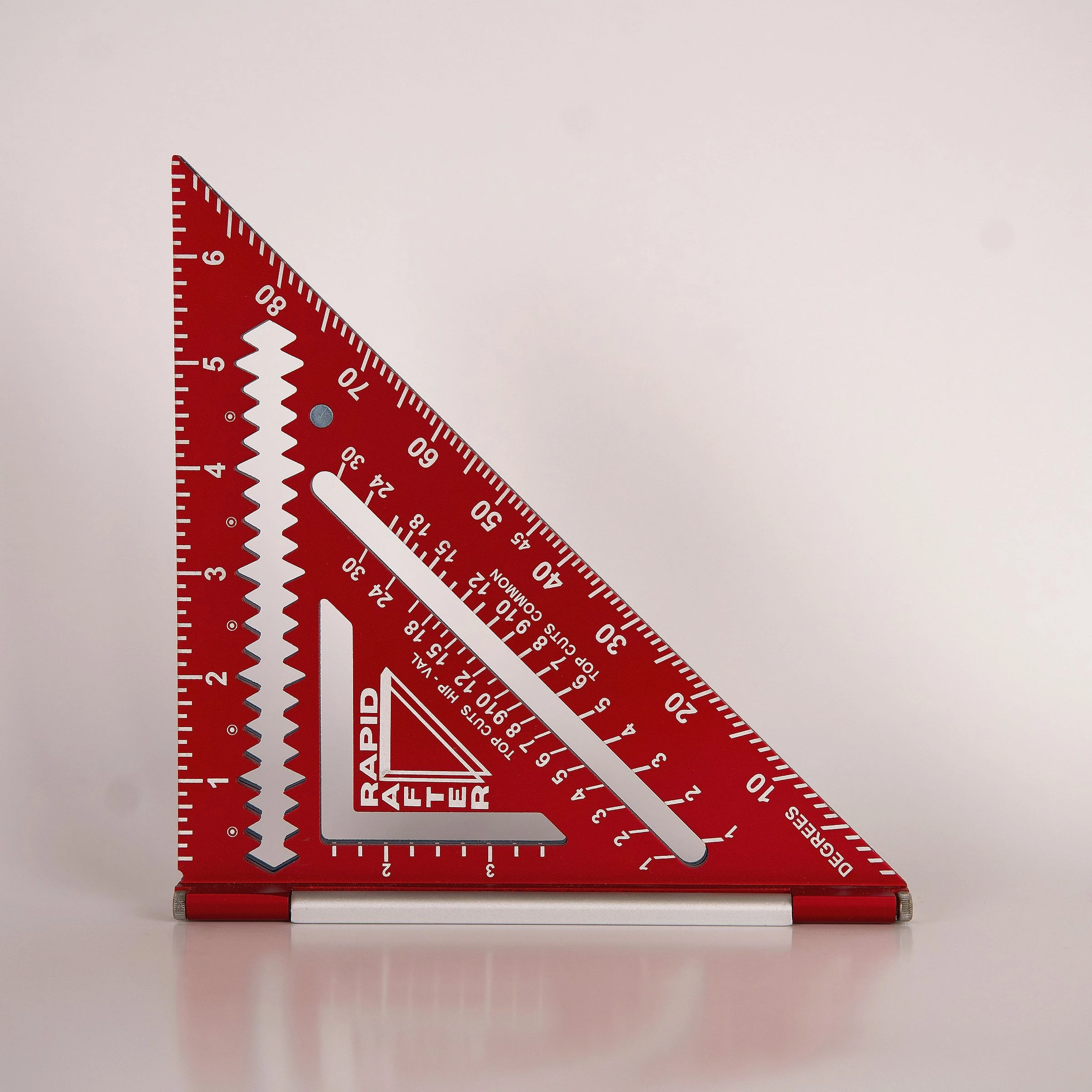
The one square on this list that marks three sides at once
- Marks three sides of 2× material in one motion: both faces and the top edge
- Aluminum body, laser-etched scales, wider scribe
- Patented double-sided square, Popular Mechanics Gear of the Year 2025
Working doubles, LVL or posts? The Pro Base-Plate Kit adds 3″, 4″ and 6″ plates, $59.99. Buy the kit
Free U.S. shipping ·30-day returns ·1-year warranty
Upgrade the square. Keep everything else.
Three sides of any 2× in one motion, then it folds flat and rides in your apron like the square it replaces.