Marking birdsmouth cuts: a step-by-step guide
The birdsmouth is where the whole roof meets the house. Two straight lines, one notch, and very little room for error. Here is how to lay it out right every time.
What a birdsmouth is
A birdsmouth, some crews say bird mouth or bird's mouth, is the notch cut into the underside of a rafter where it seats on the wall's top plate. It is made of two cuts that meet at a right angle. The seat cut is the level surface that rests flat on the plate and carries the load. The heel cut, sometimes called the plumb cut of the birdsmouth, is the vertical face that bears against the outside edge of the plate. Together they look like an open beak, which is where the name comes from.
The notch does two jobs. It gives the rafter full, flat bearing on the plate instead of a knife-edge contact, and it locks the rafter's position so the ridge lands where the plan says it should. A roof full of identical birdsmouths sits at one consistent height and plane. A roof full of slightly different ones telegraphs every difference into the shingles.
How deep to cut it
The rule of thumb is to leave at least two-thirds of the rafter's depth intact above the notch. On a 2×8, that means the birdsmouth removes no more than roughly a third of the board's depth. Many building codes limit notches at a bearing point to one-third of the member's depth, and some jurisdictions and engineered designs are stricter, so check your local code and your plans before you settle on a seat depth. The structural logic is simple: everything you cut away is depth the rafter tail no longer has, and the tail is what carries your overhang, gutter, and the ladder leaning against the eave.
A common target is a seat cut equal to the width of the plate it lands on, 3 1/2 inches for a 2×4 wall, so the rafter bears fully without the heel hanging past the interior edge. If a full-width seat would cut deeper than your allowed depth, shrink the seat, not the rule. The rafter does not need to cover the whole plate; it needs full contact on the seat it has, and enough wood left above the notch.
Laying it out, step by step
The sequence below assumes a common rafter with the pitch already known. If you are still working out lengths, start with the rafter tables on a framing square, and if rise-over-run notation is new to you, read roof pitch explained first.
1. Establish the measuring line
Snap or gauge a line parallel to the top edge of the rafter. All length measurements ride on this line.
2. Mark the ridge plumb cut
Set your square to the pitch and scribe the plumb line at the top end of the rafter.
3. Step off or measure the run
Use the rafter tables or step off with a framing square to find the heel position on the measuring line.
4. Mark the heel plumb line
At that point, scribe a second plumb line, parallel to the ridge cut. This is the vertical face of the birdsmouth.
5. Mark the seat cut
Square off the heel plumb line and mark the seat, sized to the plate width and checked against the depth limit.
6. Cut to the lines, never past them
Saw both lines only to where they meet, then finish the corner with a handsaw.
A few of those steps deserve expansion. The measuring line matters because rafter lengths from tables or calculators are measured along the slope, and you need one consistent reference from the ridge plumb cut to the heel of the birdsmouth. When you mark the heel plumb line, use the same pitch setting on your square that you used at the ridge; the two lines must be parallel or the rafter will rock. The seat is then drawn square off the heel line, level in space once the rafter is in position. Our guide to how to use a rafter square covers the pivot-and-swing technique for scribing both angles.
Cutting tips
Cut the first rafter, then test it on the actual building: heel tight to the plate, seat flat, ridge cut landing on the ridge line. Only when it fits do you mark it as the pattern and trace the rest from it, always from the same pattern, never from the last copy. When you saw, run the circular saw down each line only to the point where the two lines meet. The round blade leaves the corner uncut at the bottom of the kerf, and the correct move is to finish the corner with a handsaw, an oscillating tool, or a jigsaw. Never push the circular saw past the intersection to free the waste. The overcut is invisible from the face you sawed, but it slices across the grain right at the most highly stressed point of the tail.
The errors that ruin a roof
Two mistakes account for most birdsmouth trouble. The first is overcutting, described above: it weakens the tail and invites a split that starts at the notch and runs toward the eave. The second is inconsistency. If one rafter's seat is an eighth deep and the next is an eighth shallow, the tops of those rafters sit a quarter inch apart, and the roof plane waves. Sheathing can hide small waves; shingles in raking light hide nothing. Both errors, along with the rest of the classics, are covered in our roundup of 10 roof framing mistakes.
Inconsistency usually creeps in at the marking stage. A single-sided square marks one face of the board; to carry the birdsmouth lines to the far face, you flip the board or walk the square over the edge and re-register. Every re-registration is a chance for the far-face line to land a hair off, and when you cut from both sides, or check a cut from the back, disagreeing lines mean a sloppy seat.
Consistent marks on both faces, without flipping
The Rapid Rafterattacks exactly that step. It is a patented dual-sided square, U.S. Patent No. 11,654,545, invented by master carpenter Peter Toomey of Liberty Hill, Texas, a builder since 1984 and the founder of All Seasons Decks & Gazebos. In the open position it straddles the rafter and marks three sides of any 2× material in one motion, both faces and the top edge, so the plumb and seat marks on the far face agree with the near face by construction, not by careful flipping. Because it registers on the faces of the board, the line stays perfectly perpendicular regardless of the quality of the edge. Folded flat, it works as a normal everyday square for everything else in your apron.
The Original is made in the USA from a proprietary polymer at $27.99. The Pro is solid aluminum at $59.99, with a 3"/4"/6" Base-Plate Kit at $59.99 and a Pro Bundle at $109.99. Popular Mechanics named it Gear of the Year 2025, it won an LBM Journal 2026 Innovation Award, and it is available at The Home Depot.
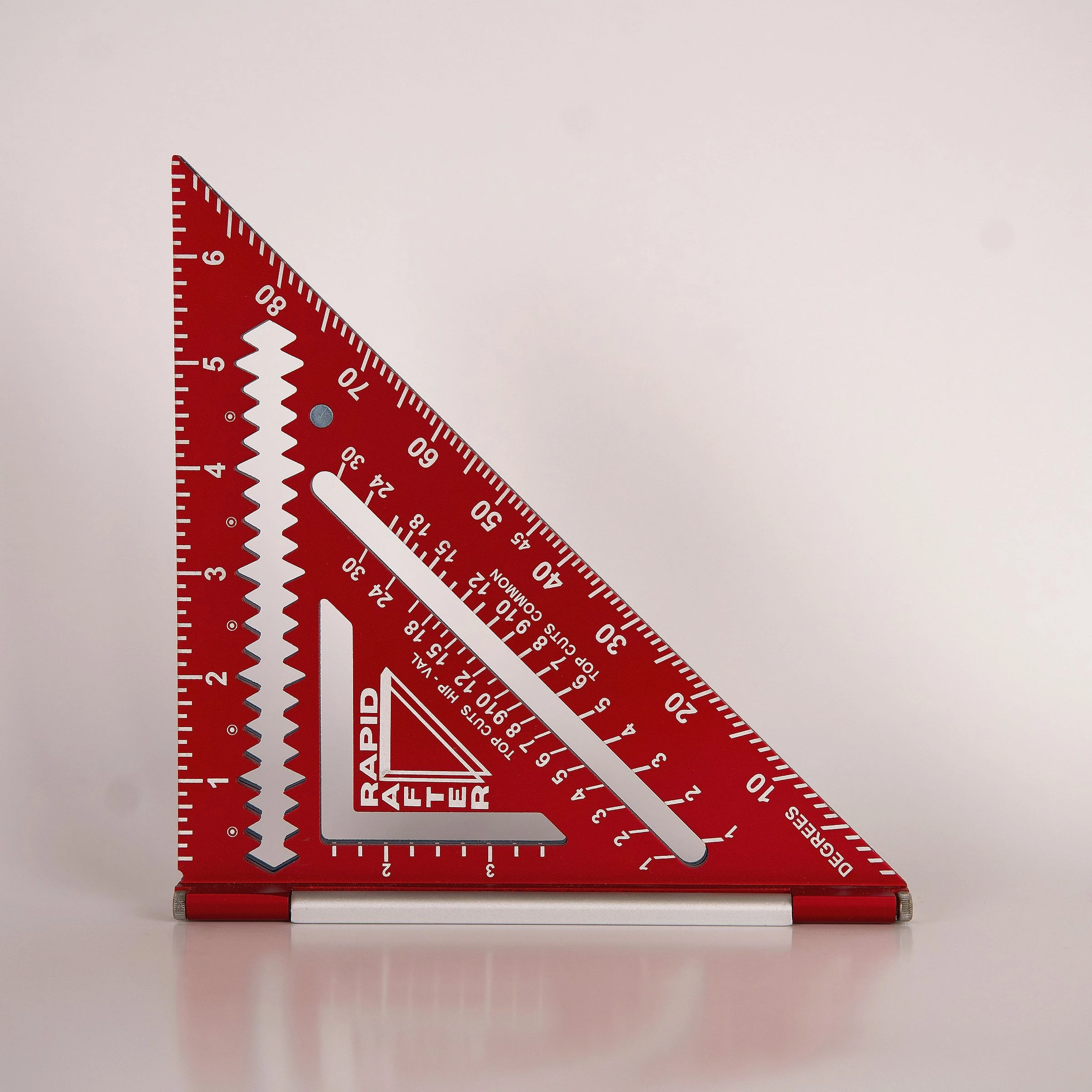
Mark the birdsmouth on three sides in one motion
- Marks three sides of 2× material in one motion: both faces and the top edge
- Aluminum body, laser-etched scales, wider scribe
- Patented double-sided square, Popular Mechanics Gear of the Year 2025
Working doubles, LVL or posts? The Pro Base-Plate Kit adds 3″, 4″ and 6″ plates, $59.99. Buy the kit
Free U.S. shipping ·30-day returns ·1-year warranty
Every birdsmouth, both faces, one motion.
Free U.S. shipping, 30-day returns, and a 1-year warranty on every square.