Roof pitch explained: how to measure, calculate, and convert it
Pitch is the first number in every roof conversation: it sets your rafter length, your material options, and whether you can walk the deck or need to rope up. Here is how it works, in plain carpenter terms.
What roof pitch actually is
Roof pitch is a ratio: how many inches the roof rises for every 12 inches it runs horizontally. Carpenters call this rise over run. A roof that climbs 4 inches for every foot of horizontal travel is a 4/12 pitch. One that climbs 12 inches per foot is a 12/12, which works out to a 45 degree slope. The run is always held at 12 inches, so the only number that changes is the rise. That convention is why every rafter square on the market carries pitch scales numbered 1 through 12: each number is a rise, and the run is baked in.
You will also hear the word slope, and in most jobsite conversation pitch and slope mean the same thing. Strictly speaking, architects sometimes reserve pitch for a rise-over-span fraction, but on the framing wall and at the lumberyard, 6/12 means 6 inches of rise per 12 inches of run, full stop.
How to read pitch notation
So what is a 4/12 pitch? Read it as "four in twelve": for every 12 inches you move horizontally toward the ridge, the roof surface rises 4 inches. You will see it written 4/12, 4:12, or just "a 4 pitch," and they all mean the same thing. The second number never changes, so a bigger first number always means a steeper roof. A 6/12 rises half again as fast as a 4/12; a 12/12 rises at a perfect 45 degrees, one inch up for every inch over.
The ratio converts to degrees with basic trigonometry: the angle is the arctangent of rise divided by run. You rarely need to do that math by hand, because the common values are published everywhere and printed on your square, but knowing the conversion helps when a phone app or a miter saw wants degrees instead of pitch.
Common roof pitches and their angles
| Pitch | Degrees | Where you see it |
|---|---|---|
| 1/12 | 4.8° | Porches, sheds, lean-tos; membrane or metal roofing only |
| 2/12 | 9.5° | Low-slope additions and patio covers; not for standard shingles |
| 3/12 | 14.0° | The usual minimum for asphalt shingles, with extra underlayment |
| 4/12 | 18.4° | Ranch homes, garages; easy to walk, sheds water fine |
| 5/12 | 22.6° | Very common on production homes; comfortable to work on |
| 6/12 | 26.6° | The classic all-around residential pitch |
| 7/12 | 30.3° | Steeper traditional homes; roof jacks start earning their keep |
| 8/12 | 33.7° | Colonial and farmhouse styles; most crews rope up or jack up |
| 9/12 | 36.9° | Steep; staging or roof jacks required for most people |
| 10/12 | 39.8° | Very steep; Tudor and chalet looks, fast-shedding snow roofs |
| 12/12 | 45.0° | A-frames, Victorians, steeples; every step is climbing |
Low slope vs. steep slope
Roofing codes and manufacturers split roofs into two broad families. Low-slope roofs, generally 3/12 and under, shed water slowly enough that standard shingles cannot be trusted to keep it out; they call for membrane systems, rolled roofing, or standing-seam metal, and at 2/12 and below shingles are off the table entirely. Steep-slope roofs, 4/12 and up, are shingle and tile territory. The dividing line matters at the design stage, because the pitch you frame determines the roofing you are allowed to install on top of it.
Three ways to measure pitch on an existing roof
1. Level and tape from under a rafter
The classic method, done safely from the attic. Hold a level horizontal with one end touching the underside of a rafter. Measure 12 inches along the level from that contact point, then measure straight up from the 12 inch mark to the rafter bottom. That vertical measurement is your rise: 5 inches means a 5/12 roof. Because you are reading the rafter itself, sheathing and shingle thickness never enter the picture.
2. From the gable end
On a gable roof you can measure from a ladder at the rake without setting foot on the roof. Hold the level against the underside of the rake overhang or the gable trim, level it, and take the same 12 inch run, vertical rise reading. It is quick, and on a windy day it beats crawling through insulation.
3. A phone level app
Every modern phone has a tilt sensor, and a free level app will read the roof surface in degrees. Lay the phone on a flat course of shingles, or better, on a straightedge or level laid on the roof so shingle texture does not skew the reading, then convert degrees back to pitch with the table above. It is the fastest check, just treat it as a field estimate and confirm with a tape before you cut lumber.
How pitch drives rafter length and materials
Pitch is not just an angle; it is a multiplier on every board you buy. The sloped distance along a rafter is always longer than the horizontal run it covers, and the steeper the pitch, the bigger the stretch. A 4/12 rafter runs about 1.05 times its horizontal run; a 12/12 rafter runs about 1.41 times. On a house with a 14 foot run per side, that is the difference between roughly 14 foot 9 inch rafters and nearly 20 footers, before you add overhangs and before you deduct for the ridge. Steeper roofs also mean more sheathing, more underlayment, and more shingles for the same footprint, which is why pitch shows up in every roofing bid.
Pitch also decides how you work. Most carpenters consider anything up to about 6/12 walkable in dry conditions with decent footwear. From 7/12 up, plan on roof jacks, staging, or fall protection, and by 10/12 you are effectively climbing, not walking. Budget time accordingly: a steep roof slows every trip up the slope.
From pitch number to plumb and seat cuts
Knowing the pitch is half the job. The other half is transferring it to lumber: the plumb cut at the ridge, the seat cut at the wall plate, and the birdsmouth where they meet. A rafter square makes that transfer mechanical, pivot on the board edge, swing to the pitch number, scribe, and our guide to how to use a rafter square walks through the whole sequence. But every one of those layout lines is only as good as the square you mark it with, and on a roof with dozens of identical rafters, small marking errors compound fast. We collected the most common ones in 10 roof framing mistakes that cost you time and lumber.
That is the problem the Rapid Rafter was built for. Invented by master carpenter Peter Toomey of Liberty Hill, Texas, who has been building since 1984 and founded All Seasons Decks & Gazebos, it is a patented dual-sided square (U.S. Patent No. 11,654,545) that marks three sides of any 2× material in one motion in the open position: both faces and the top edge. Because it registers on the faces, you get a perfect perpendicular line regardless of the quality of the board, then it folds flat and works as a normal everyday square for pitch layout and saw guiding. You can see the motion on our how it works page. The Original is $27.99, made in the USA from a proprietary polymer; the aluminum Pro is $59.99. Popular Mechanics named it Gear of the Year 2025, and it is available at The Home Depot.
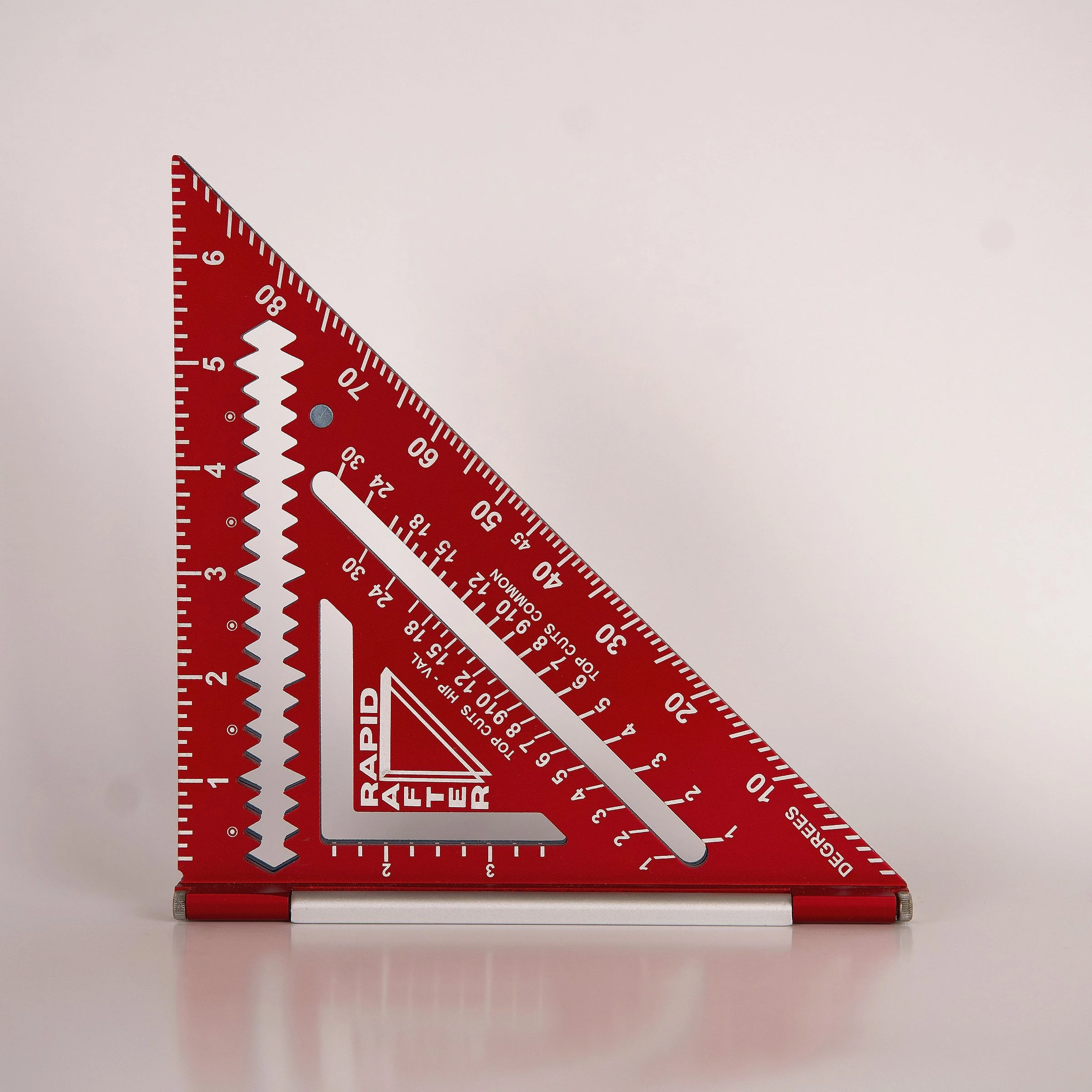
Lay out your pitch cuts without flipping the square
- Marks three sides of 2× material in one motion: both faces and the top edge
- Aluminum body, laser-etched scales, wider scribe
- Patented double-sided square, Popular Mechanics Gear of the Year 2025
Working doubles, LVL or posts? The Pro Base-Plate Kit adds 3″, 4″ and 6″ plates, $59.99. Buy the kit
Free U.S. shipping ·30-day returns ·1-year warranty
Know the pitch. Trust the line.
Every plumb cut starts with a square line around the board. The Rapid Rafter marks all three sides in one motion.