Shed roof framing: how to frame a single-slope roof
One plane, one pitch, no ridge. The shed roof is the simplest roof in carpentry, and the best place to learn rafter layout done right.
What a shed roof is, and why it is the easiest roof to frame
A shed roof, also called a mono-pitch or single-slope roof, is a roof made of one flat plane that tilts in a single direction. Water runs off one side, every rafter is identical, and there is no ridge board, no hips, no valleys, and no opposing pairs of rafters to balance against each other. That is why it shows up on lean-to additions, garden sheds, porch covers, and a lot of modern home designs: it is the least complicated roof you can build that still sheds water.
Because every rafter in a shed roof is a copy of the first one, the whole job comes down to laying out one rafter correctly. Get the pattern rafter right and the rest is production work. Get it wrong and you copy the mistake across the entire roof.
Choosing a pitch
Pitch is expressed as inches of rise per 12 inches of horizontal run: a 3/12 roof rises 3 inches for every foot it travels. On a shed roof the pitch is set by the height difference between the two bearing points, so decide it before you frame the walls, not after.
The floor for your pitch is drainage. Asphalt shingles generally want a slope of 2/12 or steeper, and in the 2/12-4/12 range most shingle manufacturers require special underlayment details because water moves slowly enough to back up under the tabs. Metal panels can typically go lower than shingles, with the exact minimum depending on the panel profile and how the seams are made. Those are the broad rules; the numbers that actually govern your roof are the roofing manufacturer's installation specs and your local code, so check both before you commit to a slope. When in doubt, steeper sheds water better, at the cost of taller walls and longer rafters.
If pitch math is new to you, our guide to roof pitch explained walks through rise, run, and slope from the ground up.
The two ways to frame a shed roof
Almost every shed roof is one of two structures, and the rafter layout is the same for both.
Ledger to wall (the lean-to). When the roof attaches to an existing building, a ledger board is fastened to the structure at the high side and the rafters run from the ledger down to the top plate of the low wall. The rafters can hang from the ledger on metal hangers or sit on top of it, depending on the detail you choose. Flashing the ledger correctly matters as much as the framing: water that gets behind a ledger rots the connection you are counting on.
Tall wall to short wall (the freestanding shed). On a freestanding building, you frame one wall taller than the opposite wall and the rafters span from plate to plate. The difference in wall height divided by the horizontal distance between the plates gives you the pitch. Frame both walls flat, check them for parallel and plumb when you stand them, and the roof plane takes care of itself.
Calculating rafter length
A rafter is the hypotenuse of a right triangle. The horizontal distance the rafter covers is the run, the vertical distance is the rise, and the rafter length between bearing points is the square root of run squared plus rise squared.
Say your run is 8 feet and you are framing at 4/12. The rise is 4 inches per foot of run, so 32 inches, or 2.67 feet. Rafter length is the square root of (8 × 8) + (2.67 × 2.67), which works out to about 8 feet 5 inches between bearing points. Add the overhang you want at the tail, plus whatever the rafter needs past the ledger or high plate, and that is your board length. Buy stock one size up so you have room to cut the tail cleanly.
Laying out the pattern rafter
Set your best, straightest board across two sawhorses, crown up, and work through the layout in this order.
1. Mark the plumb cut. At the high end of the board, use the pitch scale on your rafter square to mark the plumb cut, the vertical line where the rafter meets the ledger or high plate. Every other line on the rafter is referenced from this one, so make it clean.
2. Step off the run. From the plumb cut, measure along the rafter to locate each bearing point. You can step off the run with the square, repeating a 12 inch run increment for each foot, or measure the calculated rafter length directly. Either way, work from the plumb cut every time. Do not measure some marks from one end of the board and some from the other.
3. Mark the birdsmouth at each bearing point. The birdsmouth is the notch that lets the rafter sit flat on a wall plate: a level seat cut and a plumb heel cut. A shed rafter usually gets one at the low plate, and a second at the high plate if the rafter sits on top rather than hanging in a hanger. Keep the seat cut wide enough for full bearing on the plate without over-notching the rafter; your local code sets the limit on how much you can remove. The full step-by-step is in our guide to marking birdsmouth cuts.
4. Mark the tail. Measure past the low birdsmouth for your overhang and mark the tail cut, plumb, square, or whatever profile your fascia detail calls for. Cut the pattern rafter, test-fit it in place, and only then trace it onto the rest of your stock.
Spacing, blocking, and fastening
Shed rafters go on 16 inch or 24 inch centers, matching the wall stud layout below so loads travel straight down through the framing. Which spacing and what lumber size depends on the span, the snow load, and the species and grade of your stock: span tables in your local code book settle it, so look up your case instead of guessing.
At each bearing point, fasten the rafter to the plate with the toenails or the framing connectors your code and your inspector expect; hurricane ties are cheap insurance on any roof that sees wind. Install solid blocking between rafters over the bearing walls to keep the rafters from rolling, and use the blocking bay layout to keep your spacing honest across the roof. If the roof is more than a few rafters long, snap a line across the tails after installation and trim them in place so the fascia lands dead straight.
Common mistakes
- Inconsistent birdsmouths. If the seat cuts vary in depth from rafter to rafter, the tops of the rafters land at different heights and the roof plane ripples. Cut one pattern, trace it, and check the first few copies against it.
- Crown down. Every board has a crown, a slight bow along its length. Sight each rafter and install crown up, so the load flattens the bow instead of deepening it. One crown-down rafter shows as a dip in the finished roof.
- Measuring from different reference points. Marks measured from the plumb cut and marks measured from the other end of the board will not agree, because board lengths vary. Pick the plumb cut as your reference and measure everything from it.
- Skipping the test fit. Cutting all your rafters from an unproven pattern turns one small error into a stack of firewood. Fit the pattern rafter in place first.
These are four of the classics; we cover the rest in 10 roof framing mistakes.
The square that speeds up rafter work
Every rafter in a shed roof needs square lines carried around the stock: the plumb cut, the heel of each birdsmouth, the tail. With a traditional single-sided square that means marking one face, flipping the square over the board, re-registering, and hoping the lines meet on the far side.
The Rapid Rafter, U.S. Patent No. 11,654,545, was invented by master carpenter Peter Toomey of Liberty Hill, Texas, who has been building since 1984 and founded All Seasons Decks & Gazebos. In the open position it marks three sides of any 2× material in one motion, both faces and the top edge, and because it registers on the faces it draws a perfect perpendicular line regardless of the quality of the board. Fold it flat and it works as a normal everyday square for pitch layout and saw guiding. The Original is $27.99, made in the USA from a proprietary polymer; the aluminum Pro is $59.99, with a 3"/4"/6" Base-Plate Kit at $59.99 and a Pro Bundle at $109.99. Popular Mechanics named it Gear of the Year 2025, it won an LBM Journal 2026 Innovation Award, and it is available at The Home Depot. Free U.S. shipping, 30-day returns, 1-year warranty.
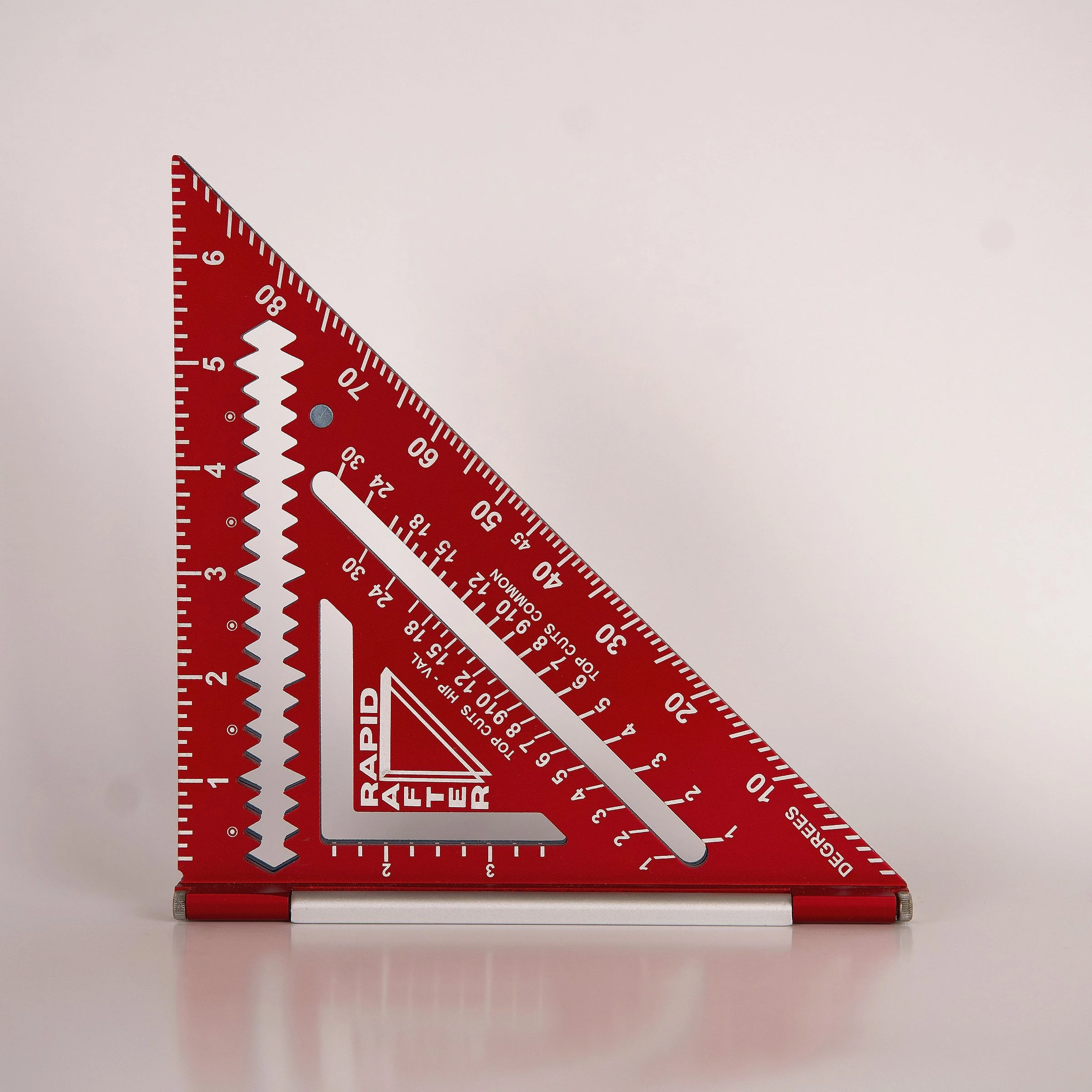
Mark every rafter for your shed roof in one motion
- Marks three sides of 2× material in one motion: both faces and the top edge
- Aluminum body, laser-etched scales, wider scribe
- Patented double-sided square, Popular Mechanics Gear of the Year 2025
Working doubles, LVL or posts? The Pro Base-Plate Kit adds 3″, 4″ and 6″ plates, $59.99. Buy the kit
Free U.S. shipping ·30-day returns ·1-year warranty
Mark every rafter in one motion.
Both faces and the top edge, one pass, no flipping. The pattern rafter has never gone faster.